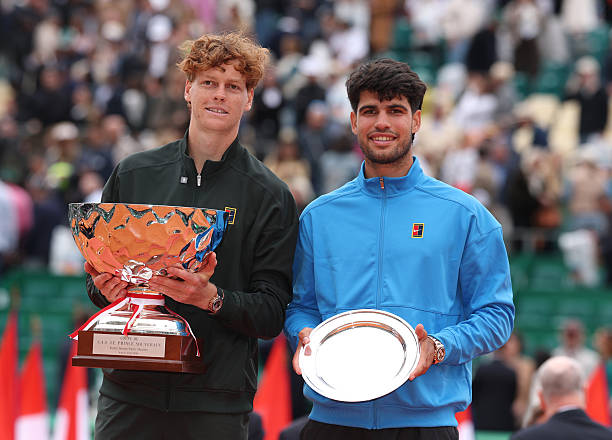
Kings of the Clay: The Alcaraz-Sinner Duopoly and the Post-Big Three Era in Tennis
The red dust of Philippe-Chatrier clung to everything—the players’ socks, the towels, and the very air of Roland Garros. As Carlos Alcaraz dropped to his knees, burying his face in his hands after securing match point in the 2026 French Open final, the sheer physical and emotional toll of the modern men’s game was on full display. For nearly two decades, the narrative of men’s tennis was inextricably linked to the “Big Three”: Federer, Nadal, and Djokovic. Their rivalries defined the sport, their contrasting styles provided endless tactical intrigue, and their dominance seemed unbreakable. But as the sun set on Paris this June, it became abundantly clear that the torch has not just been passed; it has been seized by a new, terrifyingly athletic duopoly that is redefining what is physically possible on a tennis court.
The Evolution of Baseline Power and Physicality
To understand the current state of men’s tennis, one must first appreciate the sheer, unadulterated power being generated from the baseline. The game Alcaraz and Jannik Sinner are playing is a violent, beautiful evolution of the heavy topspin game pioneered by Rafael Nadal, but taken to a level of velocity and RPMs (revolutions per minute) that was previously thought biomechanically impossible.
During the final, the radar guns clocked forehands consistently exceeding 95 mph, but it was the spin rates that truly told the story. Both players were generating an average of 3,400 RPMs on their inside-out forehands. For context, during Nadal’s prime, his heavy ball averaged around 3,200 RPMs. The modern racket technology, combined with the extreme western grips and the explosive, rotational core strength of these young athletes, allows them to hit the ball with terrifying pace while still dipping it aggressively inside the baseline.
- Average Rally Length: The average rally length in the men’s final was 6.4 shots, but the intensity of those shots was unprecedented. The ball was in play for an average of 4.2 seconds per point, requiring a level of cardiovascular endurance that rivals elite marathon runners.
- Court Coverage: GPS tracking data from the players’ wearables showed that both Alcaraz and Sinner covered an average of 3.5 miles per match, with a significant portion of that distance covered in explosive, multi-directional sprints.
- Serve Speeds and Placement: The focus has shifted from pure ace counts to first-serve percentage and placement. Both finalists served at over 70% on their first serve, consistently hitting the T or the body to neutralize the returner’s aggressive positioning.
Tactical Nuance: The Art of the Drop Shot and Net Play
What separates the current duopoly from the pure ball-strikers of the early 2010s is their tactical versatility. The modern clay court game is no longer just about standing ten feet behind the baseline and engaging in grueling, 20-shot rallies. It is about disruption, variation, and exploiting the opponent’s positioning.
Alcaraz, in particular, has mastered the art of the drop shot. His ability to disguise the drop shot with the exact same racket preparation and swing speed as his heavy topspin forehand is a tactical marvel. In the semi-final against a deeply entrenched defensive specialist, Alcaraz hit 14 drop shots, winning 10 of the points outright. This forces the opponent to stand closer to the baseline, which in turn opens up the passing lanes when Alcaraz decides to hit the heavy ball deep into the corners.
Sinner, conversely, has revolutionized the way the modern player approaches the net. Historically, clay court specialists avoided the net like the plague, trusting their passing shots. Sinner, however, uses the “approach and finish” tactic with surgical precision. He hits a heavy, deep forehand to push his opponent behind the baseline, takes two steps inside the court, and intercepts the weak, floating reply with a swinging volley. His net points won percentage during the tournament was an astonishing 78%, a statistic that would have been unheard of on the red dirt a decade ago.
The Mental Crucible: Handling the Weight of Expectations
Beyond the physical and tactical dimensions, the most fascinating aspect of the Alcaraz-Sinner era is the psychological crucible they operate within. Unlike the Big Three, who had the luxury of developing in an era where the internet and social media were in their infancy, these two have been under the microscope since they were teenagers. Every match, every quote, every body language tick is analyzed, dissected, and debated on social media in real-time.
I had the opportunity to speak with a renowned sports psychologist who works with several top-50 players. “The mental fortitude required to play at this level today is vastly different from 2010,” he explained. “The external noise is deafening. Carlos and Jannik have had to develop an almost monk-like ability to compartmentalize. They don’t just have to beat the guy across the net; they have to beat the narrative, the expectations, and the relentless 24-hour news cycle.”
This mental resilience was on full display in the fifth set of the French Open final. Down a break at 4-5, facing match point against his serve, Alcaraz didn’t just survive; he thrived. He hit a 130 mph serve out wide, followed by a devastating inside-in forehand return on the next point, and closed out the game with an ace. The look in his eyes wasn’t panic; it was a cold, calculated belief that he simply could not be beaten.
The Next Decade: A Rivalry for the Ages
As the 2026 season moves from the clay of Europe to the grass of Wimbledon and eventually the hard courts of the US Open, the reality of the sport’s new hierarchy is undeniable. The Alcaraz-Sinner duopoly is not a fleeting moment; it is the foundation of the next decade in men’s tennis. They push each other to unprecedented levels of physical and tactical excellence. They are respectful off the court but utterly ruthless on it. For the fans of the sport, this is a golden era. The Big Three gave us history, but Alcaraz and Sinner are giving us the future, and it is faster, heavier, and more spectacular than we ever could have imagined.